
3D Printing of Piezoelectric Sensors Unaffected by Electromagnetic Interference

Shutterstock
Date of publication:
Researchers from the University of Ljubljana have developed a unique method for printing advanced sensors that are not affected by electromagnetic interference. The 3D printing of sensors allows for their rapid and adaptable integration into other 3D printed structures, even in hard-to-reach places, which is particularly important in medicine, such as in customized prosthetics. At the same time, these sensors can be used to monitor the lifespan of other 3D printed structures, such as parts for the automotive industry.
Researchers Tilen Košir (M.Sc., doctoral student) and Janko Slavič (professor, PhD) from the Faculty of Mechanical Engineering have made a significant advancement in the technology of 3D printed sensors. This research, which was published in the leading scientific journal in the field, Additive Manufacturing (Link_article, IF=11.632), was enabled by a unique combination of materials and innovative 3D printing techniques. The project was partially funded by the program group ''Mehanika v tehniki'' (ARRS, P2-0263) and the research project " V enem procesu 3D natisnjeni dinamični senzorji" (ARRS J2-3045, 2021-2024).
Photo gallery
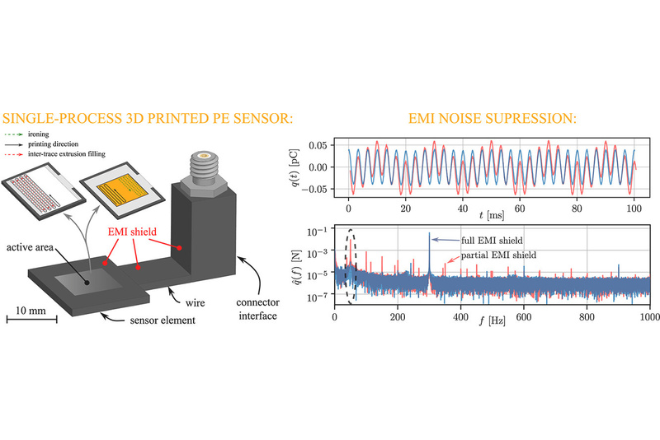
Piezoelectric sensors convert mechanical energy into electrical signals and vice versa. These sensors typically face challenges due to electromagnetic interference, which introduces excessive noise into load measurements. The researchers, using an innovative application of 3D printing, combined piezoelectric, conductive, and regular plastic materials to create a sensor resistant to such interference. Their 3D printing method not only produces the sensor but also the necessary connecting wires and interfaces, making the sensor directly compatible with conventional measuring tools. The results indicate that this sensor is extremely accurate, capable of detecting even the weakest signals without interference.
