
How nanoparticles for fuel cell applications continuously change

Vecteezy
Date of publication:
Proton exchange membrane fuel cells use hydrogen as a fuel and are one possible alternative to internal combustion engines that run on fossil fuels. The wider deployment of fuel cells, and thus the potential to reduce greenhouse gas emissions, is hampered by their cost. They require the expensive and scarce metal platinum to operate efficiently.
Nanoparticles made of platinum alloyed with cheaper transition metals such as copper can be used as catalysts to accelerate the oxygen reduction reaction, one of the chemical reactions in a fuel cell. This significantly reduces the amount of platinum used and thus the cost of the fuel cell. Despite a lot of research on the use of platinum alloys as catalysts, some longevity-related challenges remain.
In this study, the authors investigated the evolution of platinum-copper alloy nanoparticles under conditions of so-called electrochemical activation, which prepares the catalyst for long-term operation within the fuel cell. Using advanced microscopy methods and unsupervised machine learning algorithms, they showed that the changes on the nanoparticles’ surface during activation depend on the crystal structure of the surface sites.
Platinum and copper atoms can be distributed randomly across the crystal lattice, or they can occupy specific sites to form the structure of an ordered alloy. The results of the study showed that sites with an ordered alloy structure were more stable, while those with a disordered structure were more likely to lead to local collapse of the crystal structure.
Photo gallery
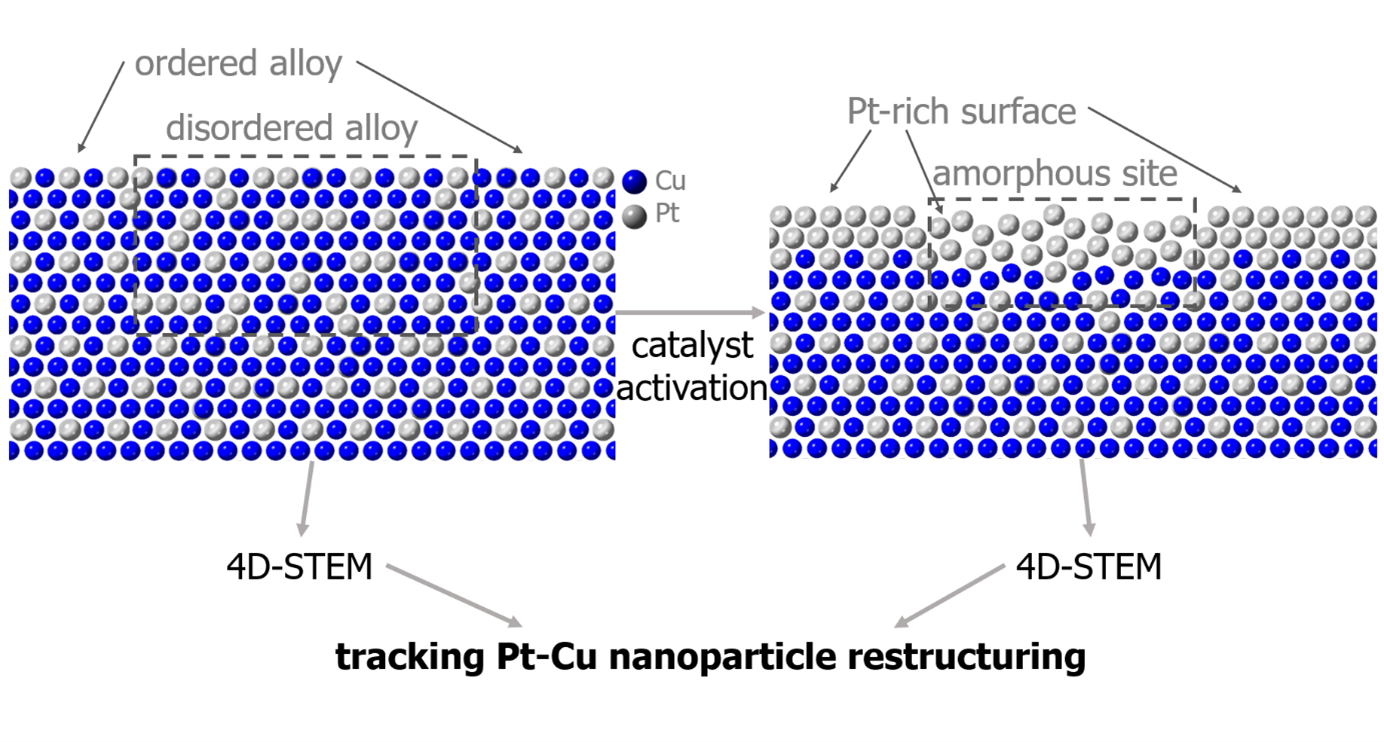
The study contributes to a deeper understanding of the relationship between the structure and stability of hydrogen fuel cell catalysts, which is crucial for the future production of materials with a longer lifetime.
The study involved researchers from the University of Ljubljana, the National Institute of Chemistry, and the University of Nova Gorica. The results were published in ACS Nano.

