
Combating the Most Dangerous Heart Diseases with High-Voltage Electrical Pulses

Canva
Date of publication:
Researchers from the University of Ljubljana, together with partners in the interdisciplinary project CardioEP Experimental and Clinical Cardiac (Electro)physiology and Cell and Gene Therapy with Electroporation, are developing therapies for the treatment of a broad spectrum of heart diseases, from the most dangerous arrhythmias to heart failure, based on electroporation.
Cardiovascular Diseases as a Global Challenge
Cardiovascular diseases are the most common cause of death worldwide. In Europe alone, approximately 133 million people live with these conditions, while in Slovenia the number exceeds 354,000. Finding more effective treatments is therefore one of the key priorities of modern medicine.
The five-year CardioEP project, led by prof. dr. Damijan Miklavčič from the Faculty of Electrical Engineering at UL, addresses this challenge by using electroporation – a phenomenon in which short high-voltage electrical pulses increase the permeability of cell membranes. This increased membrane permeability enables either the destruction of unwanted tissue (irreversible electroporation) or the delivery of therapeutic substances into cells that remain alive (reversible electroporation). Electroporation in catheter ablation (i.e. pulsed field ablation) has in recent years become established for the treatment of atrial fibrillation, the most common cardiac arrhythmia. The CardioEP project aims to extend this technology to the far more challenging ventricular arrhythmias – the most dangerous heart rhythm disorders – and at the same time apply it to entirely new areas: gene and cell therapy for the heart.
Main Project Goals
One of the key goals of the project is the development of a digital twin for the treatment of ventricular tachycardias – a computational model of the patient’s heart that, based on computed tomography (CT) and magnetic resonance imaging (MRI) scans as well as intracardiac electrograms, would use artificial intelligence methods to predict the effects of ablation. Such a tool will enable physicians to plan procedures tailored to each individual patient, which is particularly important in ventricular arrhythmias, as the cardiac wall is thicker and often already affected by scarring, and rhythm disorders in the ventricles directly threaten patients’ lives.
Using reversible electroporation, researchers will attempt to deliver therapeutic nucleic acids (e.g., microRNA) into cardiac cells to promote the regeneration of heart muscle after a heart attack. In contrast to viral methods, electroporation represents a safer delivery approach. In parallel, they will test whether electroporation can improve the retention of stem cells in cardiac tissue and thereby enhance cell therapy for patients with heart failure.
As part of the project, the researchers also plan to establish the first Slovenian laboratory for preclinical cardiac research on large animals at the Veterinary Faculty, which will enable the development and testing of new therapeutic procedures and, in the long term, strengthen the position of the University of Ljubljana in this research field.
A Broad Consortium for Ambitious Goals
The project involves more than 60 researchers, including 16 doctoral students, from four faculties of the University of Ljubljana: the Faculty of Electrical Engineering, the Faculty of Medicine, the Faculty of Computer and Information Science, and the Veterinary Faculty. External partners also play a key role – the University Medical Centre Ljubljana, which provides the clinical environment for validating new approaches, the Jožef Stefan Institute with advanced magnetic resonance imaging capabilities, and the Institute of Oncology Ljubljana with extensive experience in translating electroporation therapies into clinical practice. The long-term goal is to establish a centre for clinical and experimental cardiac electrophysiology in Ljubljana.
Photo gallery
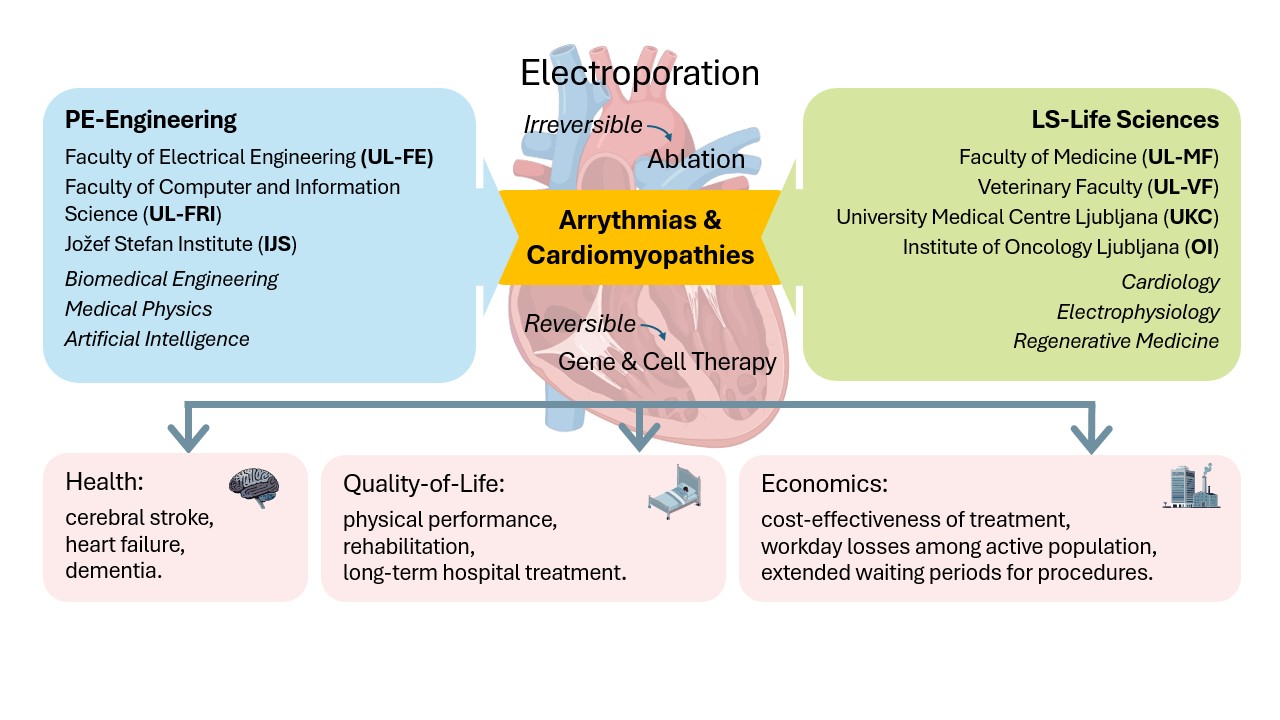
The research is funded by the University of Ljubljana within the framework of the program of large interdisciplinary projects from ARIS funds under the developmental pillar of stable funding for scientific research activity.
