
News
Customize list
-
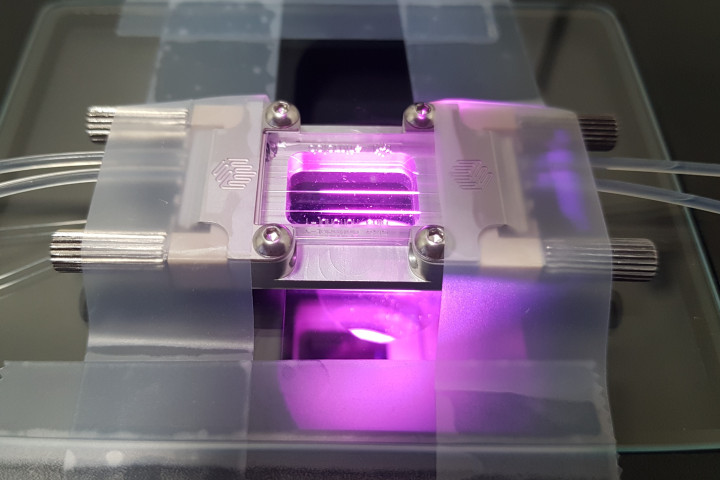
Researchers from the Faculty of Chemistry and Chemical Technology of the University of Ljubljana have obtained a Twinning project in the field of continuous (bio)catalytic processes
Under the leadership of Prof. Dr. Polona Žnidaršič Plazl, researchers from the Faculty of Chemistry and Chemical Technology of the University of Ljubljana (UL FKKT) have obtained a Twinning project titled "Twinning for Building Excellence and Innovative Solutions in Flow Catalysis" – FlowCat.
-

A new discovery important for research and treatment of dementia and ALS
Slovenian researchers led by Prof. Dr Boris Rogelj from the Faculty of Chemistry and Chemical Technology University of Ljubljana, and the Department of Biotechnology, Jožef Stefan Institute, have discovered new mechanisms associated with a mutation in the C9orf72 gene. This research is important because it further reveals the causes of two diseases – amyotrophic lateral sclerosis (ALS) and frontotemporal dementia (FTD) - and, as a consequence, increases the potential for developing new treatments for these two diseases.
-

Irregularities in hydrogen fuel cell catalysts
The increasingly evident consequences of climate change are a major motivation for the development of low-carbon technologies, among which fuel cells, using hydrogen as fuel, hold great promise. One of the obstacles to the wider commercialization of the technology is the use of expensive and rare platinum in catalysts, which is why effort goes into trying to reduce the amount of platinum used while preserving the relevant properties of these materials. For the oxygen reduction reaction, one of the reactions in a fuel cell, we use catalysts with alloyed nanoparticles containing platinum and cheaper transition metals. Since certain defects in the nanoparticle structure can occur during the preparation of the catalyst, the effects of all aspects of the structure on the performance in the fuel cell need to be studied in detail.
-

A research breakthrough in the dating of historical books
Heritage scientists can now date historical paper using only infrared light and computational analysis of spectroscopic data. In the research of postdoctoral researcher Dr. Floriana Coppola and colleagues, which is published in the top scientific journal 'Journal of the American Chemical Society', shows that it is possible to date paper extremely accurately, even to 2 years. An uncertainty this low is not possible with any other method, much less with a non-destructive method.
-

Preserving the inflatable Trump baby blimp
Researchers at the Heritage Science Laboratory Ljubljana (HSLL) of the Faculty of Chemistry and Chemical Technology, researchers at University College London (UCL) and conservators at the Museum of London have collaborated in interdisciplinary research in the field of heritage science, studying the stability and risk of displaying the 6-metre high and 3-metre wide polyvinyl chloride (PVC) inflatable. The results of chromatographic analysis of the material, studies of accelerated degradation of model samples and modelling diffusion and evaporation enabled the conservators to assess the environmental risks to the object during storage and exhibitions.


