
DNAbi: Enzymatic storage of digital data in DNA with reduced error rates
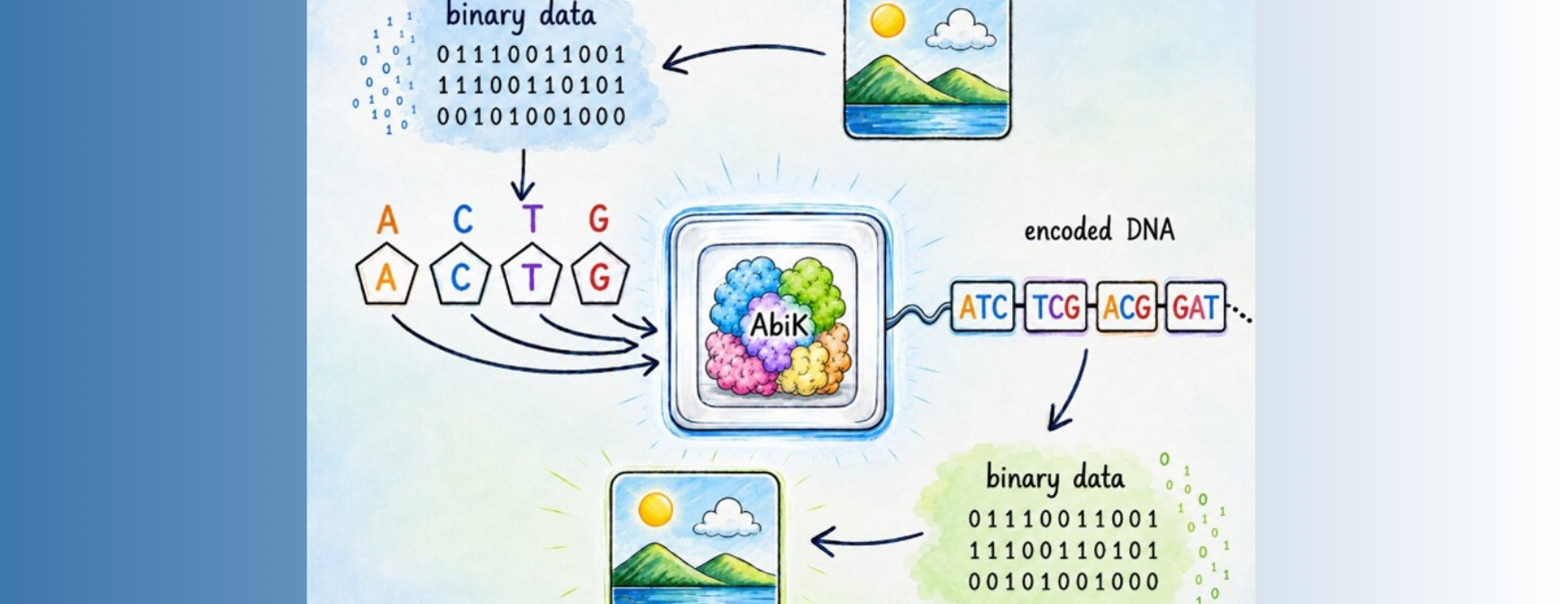
Rapid growth in digital data is driving the need for sustainable long-term storage, with DNA as a promising solution limited mainly by current synthesis methods.
Areas
Biotechnology
Fields of use
Long-term archival data storage
Current state of technology
Proof of concept, prototype (TRL 3-4).
Intellectual property
Patent application no. WO 2025/224207 A2
Developed by
University of Ljubljana, Biotechnical faculty (Slovenia) and International Institute of Molecular, and Cell Biology (Poland)
Contact
Background
Data centers currently consume approximately 2% of global electricity, with demand projected to increase substantially due to the growth of cloud computing and AI, which are driving the rapid increase in the amount of digital data that must be stored and archived. DNA is a promising long-term data storage medium because of its high information density and stability. The main bottleneck is efficient de novo DNA synthesis. Conventional phosphoramidite DNA synthesis is mature but relies on expensive reagents, nature unfriendly organic solvents, and stepwise chemistry, whereas many enzymatic synthesis approaches require engineered, costly terminator nucleotides, demanding reaction conditions, or repeated enzyme addition. Therefore, new approaches are needed
Description of invention
An innovative approach based on the catalytic activity of AbiK enzyme from Lactococcus lactis and a novel strategy for encoding the information into DNA. Using the enzyme AbiK, we synthesize DNA molecules composed of segments of random length and a sequence consisting of only three of the four natural nucleotides. The information is encoded using the absence of one nucleotide in each segment. We demonstrated that synthetic DNA enoding alphabet letters can be stored on the biosenzor chip or released from the chip, and the information subsequently read by DNA sequencing.
Main advantages
Our approach uses natural nucleotides and avoids costly reversible terminator chemistry and the innovative codec reduces susceptibility to DNA synthesis errors and mutations compared with existing enzymatic DNA writing approaches whi are based on homopolymers or reversible terminators. Potential for faster, greener and lower-cost DNA writing for data storage applications.