
Researchers from the University of Ljubljana are co-developing smart autonomous vessels for safer seas
UL FPP
Date of publication:
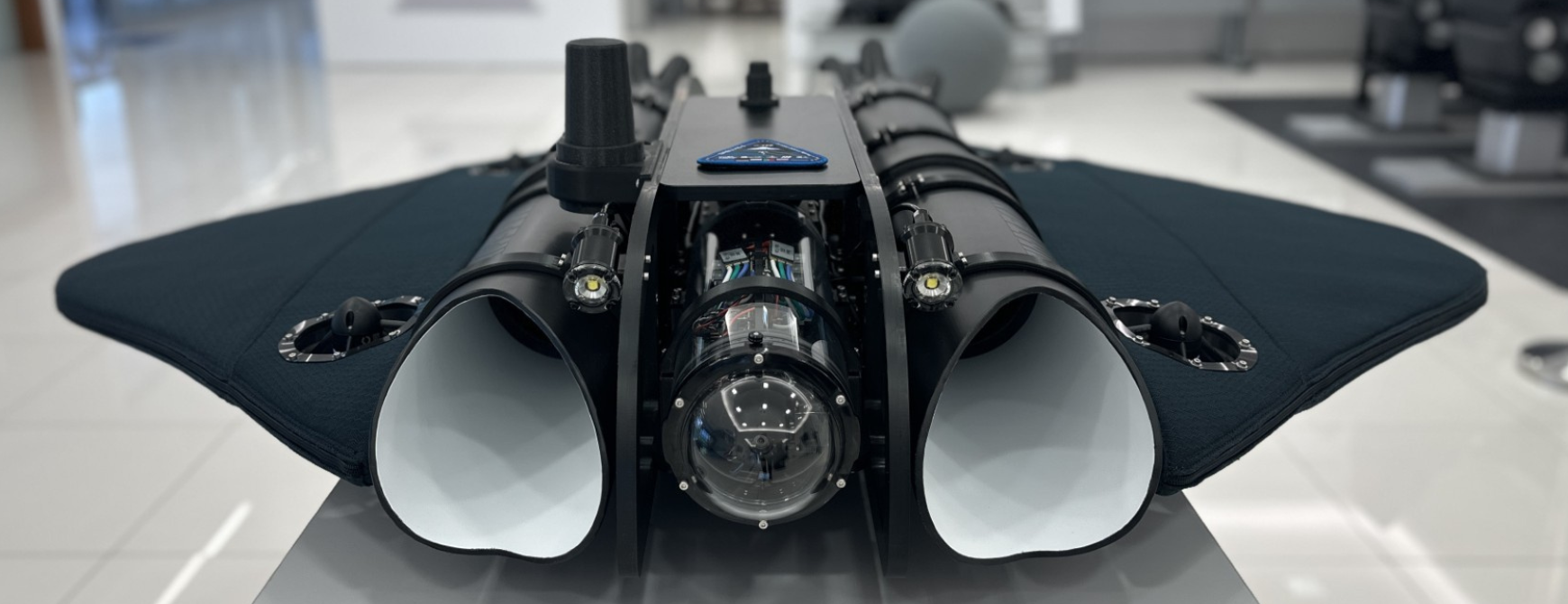
esearchers from the University of Ljubljana participated in the development of autonomous biomimetic underwater vehicles for underwater surveillance, monitoring, and reconnaissance, operating in groups (swarms or schools). This work is the result of the international project SABUVIS II, carried out under the auspices of the European Defence Agency (EDA). In addition to Slovenian partners, the project also involves partners from Germany, Poland, and Portugal.
Each project group developed its own drone model, which is interoperable with the others. With the support of the Ministry of Defence of the Republic of Slovenia, the Slovenian team included researchers from the Faculty of Maritime Studies and Transport / Department of Maritime Studies, the Faculty of Computer and Information Science / Laboratory for Artificial Visual Cognitive Systems, and the Faculty of Electrical Engineering / Laboratory for Robotics, as well as industrial partners MIL Sistemika d.o.o. and TIMTEC d.o.o. as the system integrator. Together, they developed a prototype of a dual-use autonomous underwater system designed for underwater inspection and protection of port infrastructure, seabed and critical infrastructure inspection, detection and localization of underwater mines, explosive or unexploded ordnance, search and localization of underwater intruders, inspection of navigation routes and anchorages, and execution of protective activities from the host nation support task set during visits of allied vessels.
Advanced underwater localization approaches were used to determine the position and orientation of the underwater vehicle. These approaches are based on multisensor data fusion, including multibeam sonar, three-dimensional sonar, and three-dimensional electronic charts of the underwater coastal areas and near-shore zones.
The project connects the Slovenian scientific research community with the defence industry, aiming to strengthen long-term industrial competencies in this field and to enhance the strategic role of the Republic of Slovenia in the development of innovative defence technologies. The international nature of the project further promotes the exchange of knowledge and experience, interoperability, and the active involvement of Slovenia in international initiatives and partnerships with countries that have a long tradition in the development and use of underwater technologies.
The development of an autonomous underwater system eliminates the need for direct exposure of personnel, thereby reducing operational risks and strengthening force protection.