
A Marie Skłodowska-Curie postdoctoral project to challenge narratives on migrant women
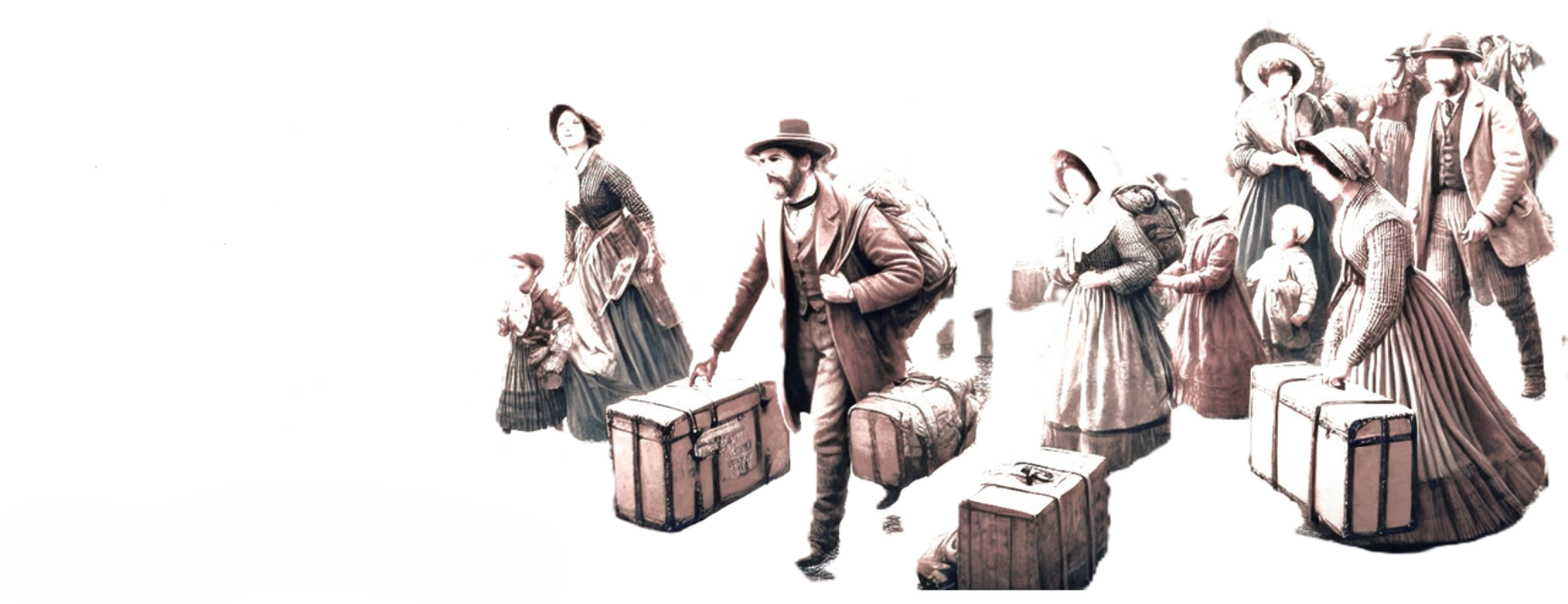
Generated by ChatGPT and elaborated by Sara Delmedico
Date of publication:
Dr Sara Delmedico (PhD, University of Cambridge) is the recipient of the prestigious Marie Skłodowska-Curie postdoctoral fellowship. As part of her fellowship, she will conduct research on how Italian-speaking women migrating from Northern Italy and the former Austro-Hungarian territories to the Americas were represented and represented themselves. She will be mentored by Professor Marta Verginella, Department of History, Faculty of Arts, University of Ljubljana.
Millions of people left Europe and migrated to the Americas in what we call the Age of Mass Migration. Many of them were Italian-speaking women travelling on their own from Northern Italy and the former Austro-Hungarian territories (particularly from the border between Italy and Slovenia). What they experienced when arriving in the host country? Was it easy to find a job? And what about politics? Did they engage in activism? Which difficulties faced as women on their own? Were they discriminated against? How they integrated in the local migrant communities? Dr. Sara Delmedico’s project Transnational Lives. The Representation and Self-Representation of Italian-Speaking Migrant Women from the Age of Mass Migration up to WWII, funded by a MSCA-PF fellowship, aims to answer to these questions by critically examine the way these women were represented and represented themselves.
Photo gallery

In particular, the project adopts a multiscalar, intersectional and comparative approach in order to highlight the complex entanglements of gender, ethnicity, labour, activism, power and representation. The study relies on two migratory centres, Buenos Aires and New York, where the presence of Italian-speaking migrant communities was significant. In these realities, migrants lived, worked and engaged in politics as testified by the presence of many ideologically aligned outlets. Women’s experiences will be investigated by reading their voices in periodicals (for example, La Nuova Civiltà or La Voz de la Mujer, published in Buenos Aires; La Questione sociale or L’Aurora published in Paterson and Hoboken, NY, respectively); by analysing photos and drawings representing migrant women; and by interviewing their relatives and friends to understand how their experiences are remembered and passed down across personal intergenerational narratives.
Delmedico’s project foregrounds migrant women’s experiences and redefines the conceptual parameters of migration studies, speaking directly to the present and fostering the development of more compassionate and humane migration policies.
Photo gallery

Altogether heritage, knowledge and shared historical memory will be valorised and will help our societies to process existing and future ruptures and continuities with our past. This will allow us to gain fundamental insights about the reverberations of migration on our present and future, therefore contributing to build a better society with mutual protection, peace, equality, inclusion and democracy at its core.
Sara Delmedico is a historian working on women, law and the press. Her recent monograph entitles Representing Violence against Women: A Case Study from Early Twentieth-Century Italy (Peter Lang, 2025).
Logos
This project is funded under the Marie Skłodowska-Curie Actions.
