
Prof. Marko Anderluh from the UL FFA awarded a prestigious MSCA Doctoral Network project

Personal archive
Date of publication:
Prof. Marko Anderluh from the Faculty of Pharmacy UL is coordinating a prestigious European MSCA Doctoral Network project that received €4.3 million in funding from the Horizon Europe framework programme. Within the LLIMIT project, partners and doctoral students will develop innovative therapeutic agents to precisely modulate the immune system by targeting lectins.
The LLIMIT project (Lectin Ligands for Modulation of Immunity) is an ambitious international research initiative focused on developing new compounds to regulate the immune system. Researchers are particularly interested in the interactions between sugar molecules on the cell surfaces and specific proteins known as lectins. Lectins act as binding agents that selectively attach to these sugar structures. These interactions play an important role in cell communication and immune response regulation. If these connections are too strong or improperly regulated, they can lead to immune system dysfunction, which weakens the body’s ability to defend itself against diseases and tumor cells. Various health issues may arise when the immune system does not function properly, such as autoimmune diseases, chronic inflammation, infections, or even the development of certain types of cancer.
The aim of LLIMIT is to develop small molecules that can precisely influence these interactions between cells and the immune system. These molecules would enable more precise control of immune responses, such as suppressing them when overactive or stimulating them when weakened. Researchers will first characterize key target macromolecules in the body, such as different types of lectins (e.g., C-type lectins, galectins, and siglecs), and then design and synthesize new molecules capable of modulating their activity. This will be followed by testing and evaluating these molecules as potential starting points for new drugs.
Photo gallery
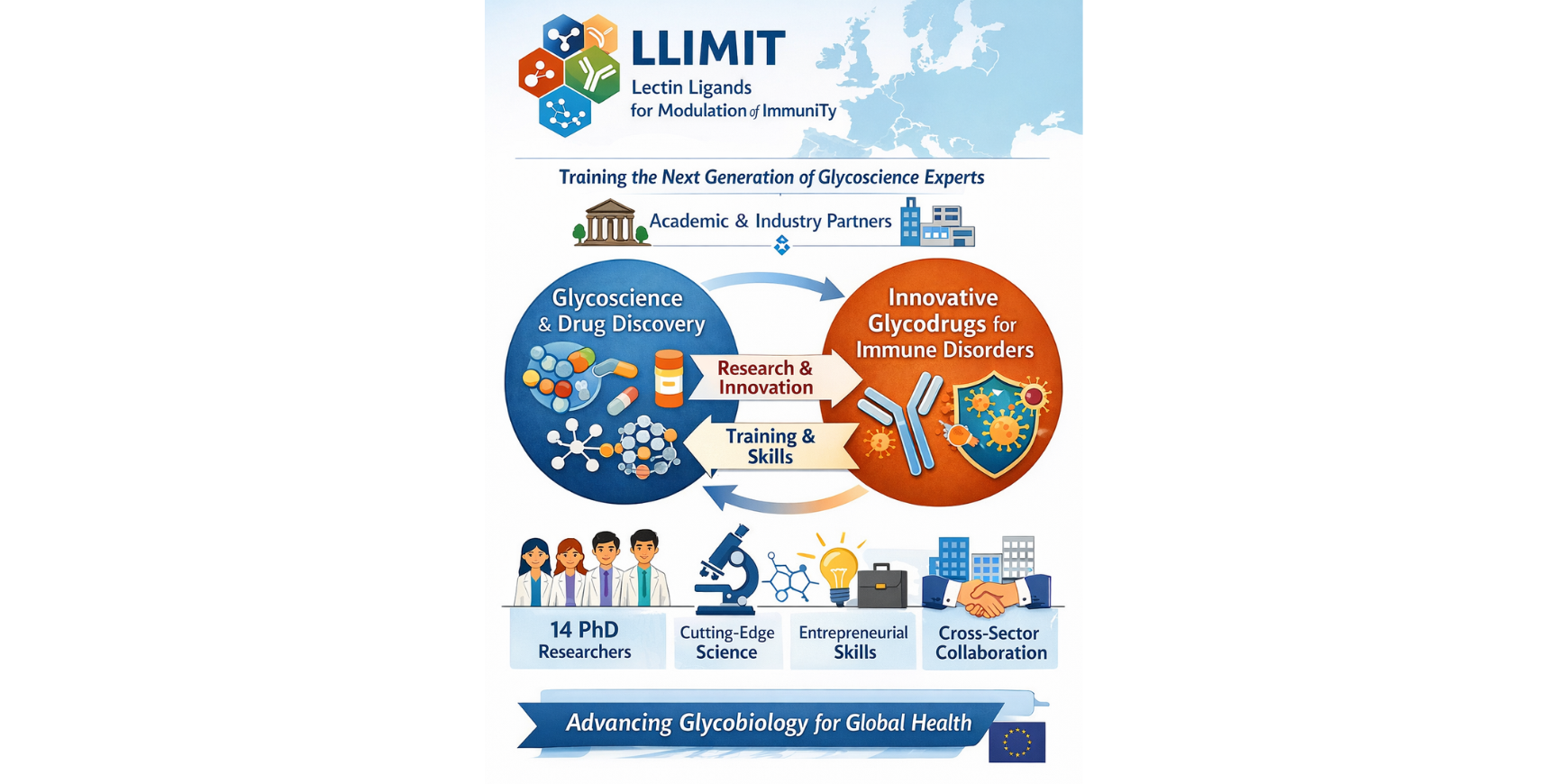
It is important to note that drug development typically takes many years or even decades, so the LLIMIT project will not yet produce final medicines for patient use. Nevertheless, its results will lay the groundwork for future therapies. The knowledge and discoveries generated by the project may contribute to the development of safer and more effective treatments for numerous diseases. Another key aspect of the project is educating a new generation of scientists. Fourteen doctoral students will gain in-depth knowledge and practical experience in the field of glycodrug development. These experts will play an important role in advancing science and strengthening Europe’s position in developing new medicines.
Photo gallery

“Through the LLIMIT project, we aim to provide a top-level interdisciplinary and intersectoral research and training platform for educating a new generation of scientists capable of conducting complex research in glycodrug design. At the same time, we aim to develop new molecules that will enable more precise regulation of immune responses,” emphasizes Prof. Marko Anderluh.
The project is funded by the prestigious Marie Skłodowska-Curie Actions Doctoral Networks programme, implemented under Horizon Europe. Such funding is a recognition of the project’s scientific excellence and its potential for long-term impact on European research.
The LLIMIT consortium includes 8 academic partners (University of Ljubljana, Lund University, Utrecht University, University of Milan, Université Grenoble Alpes, Heinrich Heine University Düsseldorf together with the associated iGRAD academy, University of Basel) and 6 industrial partners (SARomics Biostructures AB, RG Discovery AB, GLYcoDiag, Selvita d.o.o., BIMOVIS GmbH, Crelux GmbH at WuXi AppTec Co., Ltd.). The LLIMIT project thus represents an important step forward in the development of modern therapies and strengthens collaboration between academia and industry in Europe.
In addition to the LLIMIT project, the University of Ljubljana has received seven more projects in which it participates as a partner. You can view the results of Slovenian organisations here.
Logos
The project is funded under the Marie Skłodowska-Curie Actions programme.
