Slovenia gains the cutting-edge FRIDA supercomputing infrastructure

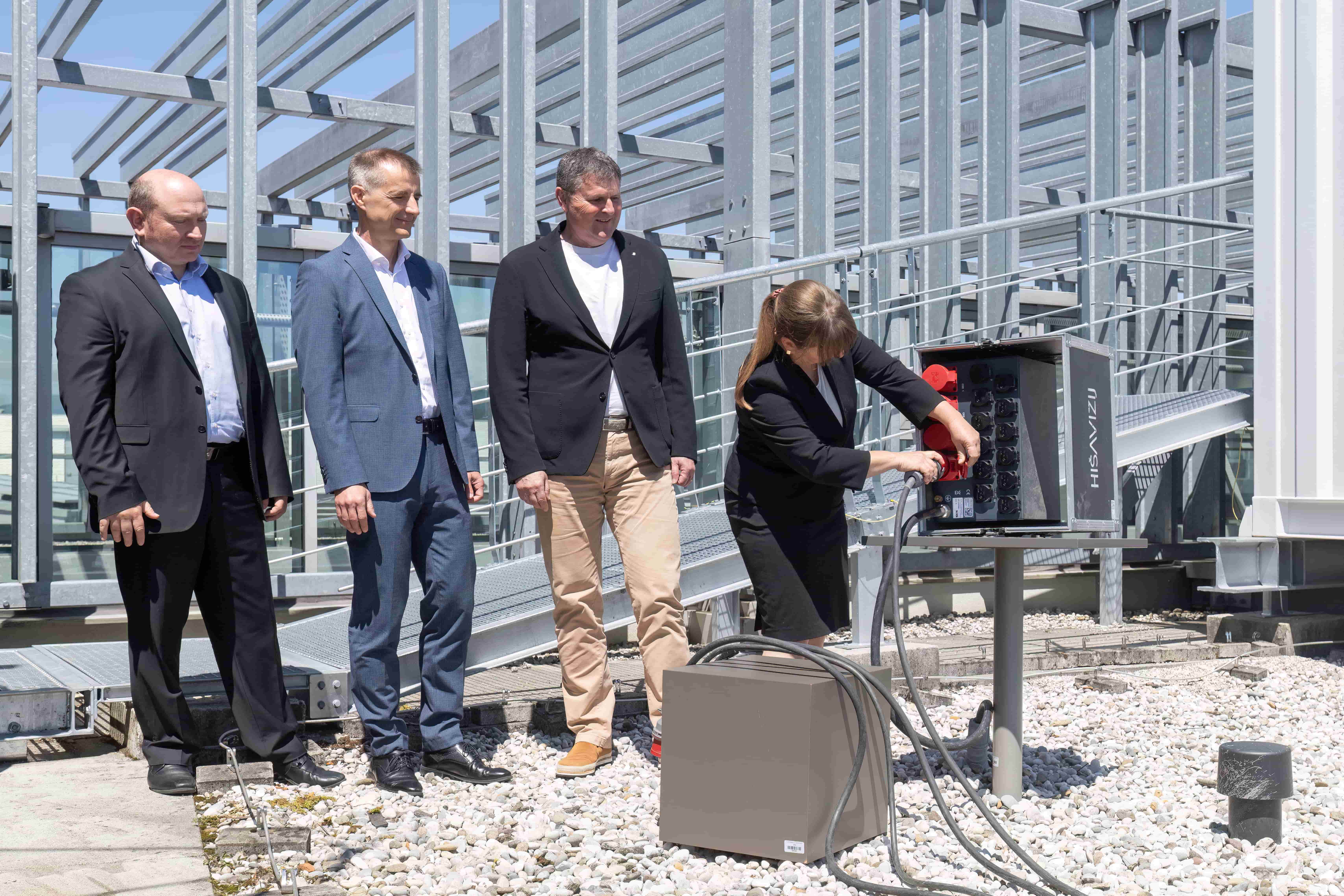
FRIDA goes live. Photo: UL FRI
Date of publication:
On Tuesday, 16 June 2026, the University of Ljubljana Faculty of Computer and Information Science (UL FRI) launched FRIDA, a high-performance data centre and new supercomputing infrastructure designed to support research and development partnerships. The opening event was attended by Dr Tomaž Boh, Director-General of the Science and Innovation Directorate at the Ministry of Education, Science and Youth (MIZM); Prof. Dr Gregor Dolinar, UL Vice-Rector for Research and Development; and more than 150 representatives from academia and the business sector.
Located on the roof of UL FRI, FRIDA is a new supercomputing infrastructure designed to address some of today’s most demanding research and development challenges. It is primarily dedicated to artificial intelligence (AI) and machine learning, large language models, scientific computing, and big data processing. It will serve researchers and students at UL FRI as well as companies seeking to develop advanced AI solutions. “FRIDA directly supports the mission of FRI, one of the key drivers of technological development in Slovenia, by bridging world-class research expertise with state-of-the-art infrastructure, enabling breakthroughs in AI and supercomputing. It offers the Slovenian economy a platform to test future technologies, which we believe will provide a significant competitive advantage. FRIDA supports innovation and opens up new opportunities for interdisciplinary projects connecting researchers with both industry and the wider society,” said Assoc. Prof. Dr Mojca Ciglarič, Dean of UL FRI, in her opening address.
Cutting-edge technology at FRIDA’s core
UL FRI highlights that FRIDA was born out of a desire for the faculty to have its own infrastructure. With its AI-focused performance, it transcends being a "local experiment" and serves as an excellent complement to the European EuroHPC ecosystem. What makes FRIDA particularly distinctive is its heterogeneous architecture and cutting-edge technology. At its core, it combines 104 graphics accelerators from seven generations. Of these, 64 are the latest generation accelerators, connected via a high-performance network. Models that previously required weeks of training can now be trained in hours or days. In essence, FRIDA is not merely a powerful computer, but a development platform. “High-performance computing infrastructure, particularly based on GPU (graphics processing unit) servers, is a prerequisite for work in AI. With its strong focus on AI, FRIDA is currently the most powerful computing centre in Slovenia. Among other things, it will support the continued development of GaMS, the Slovenian large language model, while enabling businesses and the public sector to test and prototype the latest agentic technologies,” added Prof. Dr Marko Robnik Šikonja of UL FRI.
Turning knowledge into breakthrough innovation
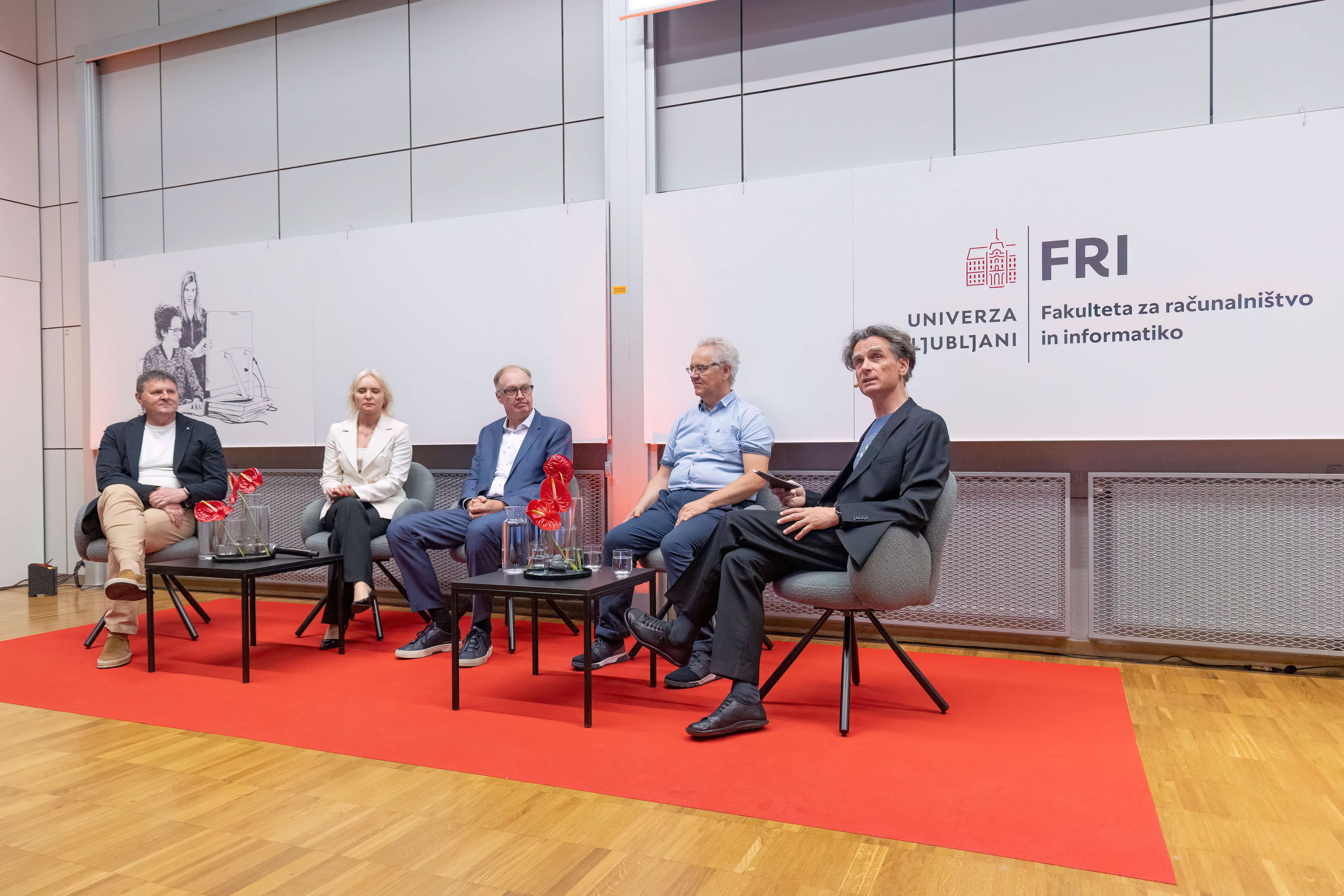
According to the latest Development Report by the Institute of Macroeconomic Analysis and Development (IMAD), Slovenia is facing a lag in data-driven development. FRIDA provides one response to this challenge, as the latest AI cannot be developed without supercomputing infrastructure. It will allow research potential to be more effectively translated into competitive development solutions and higher added value. This was discussed at the event by Valter Leban, MSc, President of the Management Board of the Kolektor Group; Vesna Prodnik, MSc, Member of the Management Board of Telekom Slovenije; Tomaž Gornik, Director and Founder of Better; and Prof. Dr Marko Robnik Šikonja of UL FRI. These companies already cooperate with UL FRI on a range of research and development projects
The speakers emphasised that cooperation with faculties and building an ecosystem of different stakeholders is the foundation of development. “It is important that knowledge does not remain within the faculty but is transferred to industry,” said Prodnik, advising those present not to seek perfection during development, but to dare to prototype and test solutions with users early on. Gornik likewise emphasised that the wave of change brought about by AI will not be successfully navigated without cooperation with academia. Leban advised the company representatives present to begin by acknowledging that no one knows everything or can do everything alone. “I always feel ‘free’ at FRI because I know that I will find answers to my ‘why’ here,” Leban said, describing the existing cooperation between Kolektor and UL FRI.
The opening event was also attended by representatives of NVIDIA, supplying FRIDA with state-of-the-art equipment, including powerful GPU servers and the software environment on which its artificial intelligence systems run.
FRIDA is the first academic supercomputing infrastructure in the region to feature NVIDIA’s Blackwell-generation B200 and B300 GPUs designed specifically for AI. When it comes to AI, the new system provides twice the training performance and energy efficiency of Slovenia’s Vega supercomputer. It is capable of up to 708 petaflops, which translates to 708 quadrillion lower-precision computing operations per second. Furthermore, it has exascale potential. In lower-precision sparse-matrix computations, it can achieve twice that speed – 1.42 exaflops, or 1.42 quintillion computing operations per second. Put differently, even if every resident of Slovenia were to perform calculations continuously, 24 hours a day, FRIDA would complete more calculations in one second than they could collectively perform in 10,000 years. FRIDA has been built as a modular containerised data centre with hybrid cooling, combining air cooling with advanced direct-to-chip liquid cooling. This is essential for modern AI servers, which generate exceptionally high thermal loads.
Photo gallery
-

FRIDA goes live: Dr Tomaž Boh, Science and Innovation Directorate at MIZM; Prof. Dr Gregor Dolinar, UL Vice-Rector; Valter Leban, MSc, Kolektor Group; Assoc. Prof. Dr Mojca Ciglarič, Dean of UL FRI.
Author: Photo: UL FRI
-

Dr Mojca Ciglarič, UL FRI; Dr Gregor Dolinar, UL Vice-Rector; Valter Leban, MSc, Kolektor Group; Dr Tomaž Boh, Science and Innovation Directorate at MIZM; Assoc. Prof. Dr Iztok Lebar Bajec, UL FRI.
Author: Photo: UL FRI
-

Assoc. Prof. Dr Mojca Ciglarič, Dean of UL FRI.
Author: Photo: UL FRI
-

Valter Leban, MSc, Kolektor Group; Vesna Prodnik, MSc, Telekom Slovenije; Tomaž Gornik, Better; Prof. Dr Marko Robnik Šikonja, UL FRI; and moderator Jure Longyka.
Author: Photo: UL FRI