
News
Customize list
-

Why Gas Content Matters for Cavitation: The Hidden Role of Tiny Gas Bubbles
Cavitation plays a key role in many technologies – from ultrasonic cleaning to chemical processing – but can behave unpredictably depending on the quality of the liquid. It is influenced not only by dissolved gases, but also by small undissolved gas bubbles.
-

University of Ljubljana again among the world’s top 400 universities in ten subjects in QS rankings
The 16th edition of the QS World University Rankings by Subject was published in March 2026. The University of Ljubljana (UL) repeated last year’s success, ranking among the top 400 universities worldwide in ten subjects and among the top 500 worldwide in 12 subjects.
-

EUTOPIA_HEALTH at UL: From the Biological Impact of Digital Environments to the Challenges of Addiction
On March 11, as part of the international EUTOPIA_HEALTH project, the University of Ljubljana hosted a day packed with content dedicated to the intersection of health and digitalization. Through a morning expert panel and an afternoon Science Café, the event offered a comprehensive look into the future of medicine, where technology is no longer just an external tool but a biological factor that influences our epigenome. Experts from various disciplines highlighted the path from advanced clinical solutions, such as socially intelligent robots, to the urgent need for digital market regulation to protect users’ mental health.
-

Recipients of the 6th University of Ljubljana Innovation Fund announced
The evaluation committee selected six projects from among those submitted. The selected projects are distinguished by strong interdisciplinarity and address key challenges of the present day. They cover sustainable materials, biodiversity protection, medicine, energy, quality of life and the development of advanced therapeutic solutions. Through their innovations, they contribute to a more sustainable future, improved health and quality of life, and the development of advanced technologies with a direct societal impact.
-
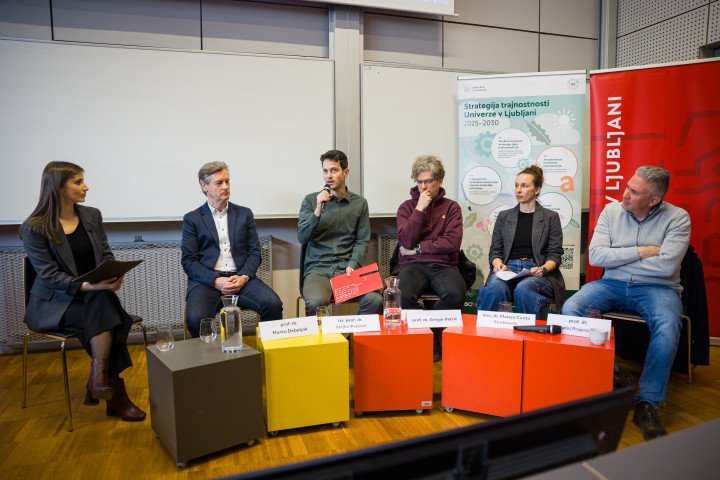
Only if artificial intelligence is developed responsibly will it be capable of supporting a sustainable future
On 16 March we opened this year’s Food For Thought festival at the Faculty of Computer and Information Science (UL FRI) with a round-table discussion titled “Code to Drive a Better World: Challenges and Opportunities in the Development of Artificial Intelligence for Delivering a Sustainable Future”. The discussion focused on how AI might support sustainable development goals, and where the new environmental, social and ethical issues could arise.
-

University of Ljubljana receives the ED.VITA Grand Prize for its ULTRA project
The University of Ljubljana (UL) has received the ED.VITA Grand Prize for the “UL for a Sustainable Society – ULTRA” project. Prizes for individual categories have also been won by the Academy of Fine Arts and Design, the Biotechnical Faculty, the Faculty of Chemistry and Chemical Technology, the Faculty of Natural Sciences and Engineering, the Faculty of Education and the Veterinary Faculty. The ED.VITA prize is the first and only national award designed to recognise sustainable initiatives and practices in higher education.
-

Pi Day 2026: Alja Dizdarević the winner by reciting Pi to 1,532 digits
The Faculty of Mathematics and Physics held its traditional Pi recitation and “Pi Bake” contests on Friday 13 March. The new PI-Pong category, which will be properly introduced next year, was also presented at the event.
-

Cup of Knowledge with Eva Mustafa and Gašper Korat: From a student idea to the Nonstop Food company
At March’s “Cup of Knowledge” gathering, we looked at how a student idea could grow into a successful enterprise story. Eva Mustafa and Gašper Korat, co-founders of Nonstop Food, shared their experiences with the participants by tracing the path they had taken from their first student attempts to the development of an innovative food company.
-

A Marie Skłodowska-Curie postdoctoral project to challenge narratives on migrant women
Dr Sara Delmedico (PhD, University of Cambridge) is the recipient of the prestigious Marie Skłodowska-Curie postdoctoral fellowship. As part of her fellowship, she will conduct research on how Italian-speaking women migrating from Northern Italy and the former Austro-Hungarian territories to the Americas were represented and represented themselves. She will be mentored by Professor Marta Verginella, Department of History, Faculty of Arts, University of Ljubljana.
-

University of Ljubljana and Italy’s National Research Council sign agreement on scientific cooperation
On 12 March 2026 the University of Ljubljana signed a cooperation agreement with Italy’s National Research Council (CNR), the country’s largest public research institution. The agreement will strengthen scientific cooperation between researchers at both institutions and encourage the development of joint research initiatives across a range of scientific fields.
-

The BIOMASS Satellite Reveals How Much Carbon the World’s Forests Store
The BIOMASS satellite of the European Space Agency (ESA) enables, for the first time, the measurement of forest biomass volume from space. New satellite data reveal how much carbon dioxide forests store and how important they are for understanding climate change. Researchers from the Faculty of Civil and Geodetic Engineering of the University of Ljubljana (UL FGG) are also involved in research and education activities
-

University of Ljubljana and Ministry of Higher Education, Science and Innovation sign funding agreement for new Faculty of Mechanical Engineering building
A funding agreement for the new Faculty of Mechanical Engineering building at the University of Ljubljana, one of the University’s biggest construction and research projects, was signed today by Rector Gregor Majdič and Minister Igor Papič. It is an ambitious project financed through the European Regional Development Fund under the 2021–2027 European Cohesion Policy programme and by the Ministry of Higher Education, Science and Innovation, with construction set to begin in 2026 and completion planned for June 2029.
-
![IMG_0073[1].jpeg](/assets/Kabinet/A-Novice/2026-03-04-Obisk-francoske-veleposlanice/IMG_00731__FocusFillWyIwLjAyIiwiLTAuMzUiLDcyMCw0ODBd.jpeg)
The Rector of the University of Ljubljana Hosts the Ambassador of France to Slovenia
The Rector of the University of Ljubljana prof. dr. Gregor Majdič today welcomed Her Excellency Ms Fabienne Runyo, the Ambassador of France to Slovenia, at the Rectorate. The meeting reaffirmed the exceptionally rich and active cooperation between the University of Ljubljana and numerous French higher education and research institutions.
-

EU–Canada cooperation at the centre of discussions at UNICA Days 2026
UNICA Days 2026, devoted to discussion of the future directions of academic cooperation between the European Union and Canada, took place in Brussels between 25 and 27 February at the University Foundation building and at the European Parliament. The event, entitled “Shared Values, Shared Futures: A Roadmap for EU–Canada Academic Cooperation”, brought together leading representatives of universities from both regions.
-
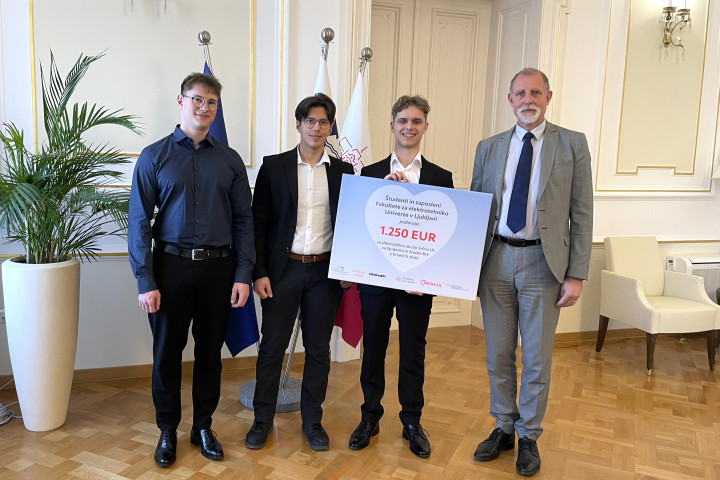
Student ambassadors of UL FE once again show strong support for the Srčna UL charity campaign
The road to an inclusive and equal society is paved with compassion and cooperation, as demonstrated once again by the students of the Faculty of Electrical Engineering of the University of Ljubljana (UL FE), who have renewed their support for the Srčna UL charity campaign. During Charity Week they raised €1,250 for the initiative, which the University of Ljubljana (UL) organises in cooperation with the Association of Friends of Youth of Slovenia, around half as much again as last year, when €772.11 was collected.
-

Food For Thought Festival 2026: Sustainable Digitalisation and Digitalisation for Sustainability
Between 16 and 26 March, the University of Ljubljana will host the third edition of the Food For Thought Festival, a series of events dedicated to addressing current societal challenges related to sustainability. This year’s festival will focus on the sustainable aspects of digitalisation, and on the synergies and deviations between the two development priorities/transitions: the green transition and the digital transition.
-

GreenHer Launches Operations and Puts Slovenia at the Forefront of European Heritage Science
The GreenHer Centre of Excellence for Green Heritage Science has today entered its operational phase, marking an important milestone in the development of Slovenia’s first interdisciplinary centre dedicated to sustainable research and innovation in the field of cultural heritage. The Centre operates as an autonomous unit within the University of Ljubljana and brings together numerous established Slovenian researchers in this field.
-

Cavitation Bubbles: How “Bursting” Micro-explosions Can Create Better Chitosan
Researchers from the Faculty of Mechanical Engineering UL and the Institute of Chemistry have developed a new, faster, and more environmentally friendly method for preparing low molecular weight chitosan. In their work, they utilized cavitation—a clean, fast, and efficient technology that could replace some less sustainable existing methods. This breakthrough opens the way for the development of a new generation of materials that could be used in medicine, pharmacy, food applications, industry, and environmental solutions.
-
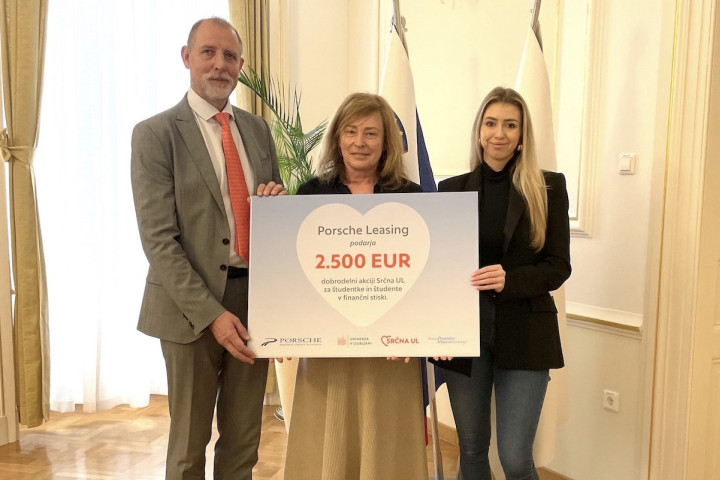
Porsche Leasing supports the Srčna UL charity campaign with a €2,500 donation
Porsche Leasing has joined the Srčna UL (Warm-Hearted UL) charity campaign as a donor. The University of Ljubljana has been carrying out this initiative since 2021 in cooperation with the Slovenian Association of Friends of Youth. Porsche Leasing’s donation of €2,500 makes a significant contribution to supporting students who, due to various life circumstances, have found themselves in financial distress.
-

How prepared is society for a potential outage of global satellite navigation systems?
Modern society is increasingly dependent on global satellite navigation systems (GNSS) such as GPS, Galileo and BeiDou. These systems are no longer merely a navigation aid; rather, they represent the invisible backbone of modern societies—supporting everything from transport and energy to banking, telecommunications, and emergency services. The key question is whether society is even aware of how deeply it is intertwined with this technology, and how unprepared it may be for a potential outage.


![IMG_0073[1].jpeg](/assets/Kabinet/A-Novice/2026-03-04-Obisk-francoske-veleposlanice/IMG_00731__FocusFillWyIwLjAyIiwiLTAuMzUiLDcyMCw0ODBd_ExtRewriteWyJqcGVnIiwid2VicCJd.webp)


